Training zones, explained
Training zones split your power into seven bands, each set as a share of your FTP and each training something different. Most of your riding belongs in zone 2, a little of it much higher. That mix is what makes you faster.
By Niels Meereboer, who makes VeloWatt Pro
Why zones
Ride everything at the same moderately hard pace and you end up too tired to go really hard, and never easy enough to recover. Zones fix that. They tell you how hard each part of a session should be, in watts that fit you, because they are worked out from your own FTP.
The seven zones
The share of FTP sets each zone. How it feels is the quickest check that you are in the right one.
| Zone | Share of FTP | How it feels |
|---|---|---|
| Z1 Recovery | under 55% | Barely working; you could chat all day |
| Z2 Endurance | 55–75% | Easy and steady; full sentences |
| Z3 Tempo | 75–90% | Purposeful; a few words at a time |
| Z4 Threshold | 90–105% | Hard and controlled; talking is a chore |
| Z5 VO2max | 105–120% | Very hard; minutes feel long |
| Z6 Anaerobic | 120–150% | All you have for a minute or so |
| Z7 Neuromuscular | above 150% | A flat-out sprint of seconds |
What each zone trains
- Z1 Recovery gets the blood moving after hard days without adding fatigue.
- Z2 Endurance is the base: it makes your heart and muscles better at using oxygen and fat, and it lets you ride for hours. Most of your time belongs here.
- Z3 Tempo builds steady strength for long climbs and long days.
- Z4 Threshold raises your FTP itself. Intervals of eight to twenty minutes are the classic form.
- Z5 VO2max lifts the ceiling above your FTP. Efforts of three to eight minutes, with as long to recover.
- Z6 Anaerobic trains the punch for a short climb or a gap to close. Efforts of thirty seconds to two minutes.
- Z7 Neuromuscular is the sprint: a few seconds, all out, and a long rest.
Building a week
Most riders improve best with plenty of easy riding and a little very hard riding, and not too much in between. With five hours a week, a good pattern is:
- Two harder sessions of about an hour, with a day or more between them: one at threshold (Z4), one at VO2max (Z5), each wrapped in a proper warm-up and cool-down.
- Two or three easy rides in zone 2, one of them longer.
- One rest day at least. Every fourth week, ride less and recover.
Power or heart rate?
Power shows what you are doing this second; heart rate shows how your body is answering, a minute later. For intervals, power is the measure to follow: a five-minute effort is over before your heart rate has settled. Heart rate is still worth wearing. If it runs high for watts you know well, you are tired, warm or coming down with something.
Zones follow your FTP
Because every zone is a share of your FTP, your zones are only as good as that number. Test again every six to eight weeks, and your zones, and every workout built on them, move with you.
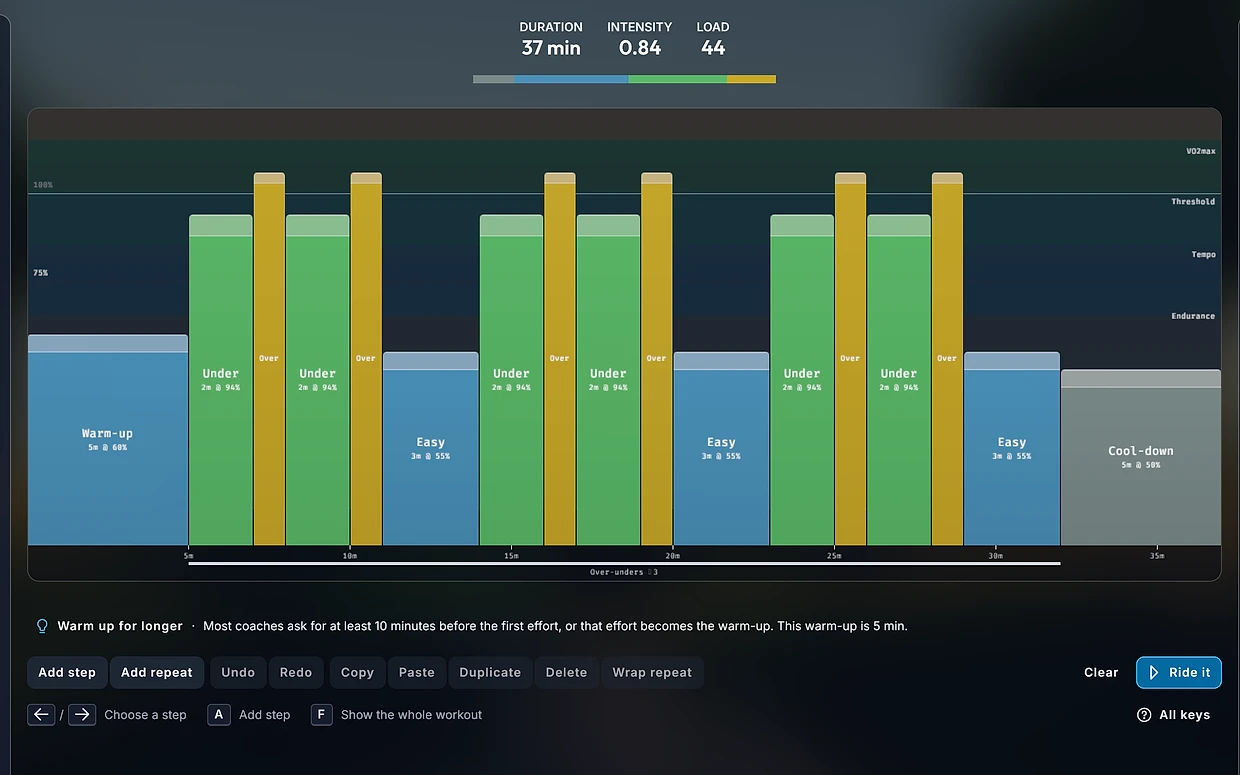
In VeloWatt Pro each block of a workout is coloured by its zone, the same seven colours as here, and in ERG your trainer holds the watts so you stay in the zone the session asks for.
Questions
What is sweet spot?
Riding at roughly 88 to 94% of your FTP: the top of tempo and the bottom of threshold. It trains much of what threshold does, at a cost you can recover from sooner, which makes it popular with riders short of time.
Should all my easy rides be in zone 2?
Most of them. Zone 1 is for recovering, and an easy ride that drifts into zone 3 makes you tired without making you much fitter.
Why do different apps have different zones?
There are several ways to split the range, with five, six or seven zones. The seven here, from under 55% to above 150% of FTP, are the zones VeloWatt Pro uses everywhere.